

Bank of America: Mortgage rates could hit 5.0% under these conditions
Want more housing market stories from Lance Lambert’s ResiClub in your inbox? Subscribe to the ResiClub newsletter.
Last week, the average 30-year fixed mortgage rate tracked by Freddie Mac hit a calendar-year low of 6.35%. It’s likely this week’s reading could come in even lower given that the daily rate reported by Mortgage News Daily was 6.13% on Tuesday.
In recent months, the average 30-year fixed mortgage rate has edged down.
Part of the decline can be attributed to a continued gradual compression of the “mortgage spread”—the difference between the 10-year Treasury yield and the average 30-year fixed mortgage rate—as some investors slowly regain their appetite for mortgage-backed securities (MBS) and help fill the void left by the Federal Reserve when it stopped buying MBS in spring 2022.
The other factor putting downward pressure on mortgage rates—and long-term yields—has been a recent stretch of softer-than-expected labor market data and financial market’s growing expectation that the Fed will shift policy from restrictive to neutral.
Even though the Fed’s expected short-term rate cuts haven’t happened yet (a 25 bps Fed cut is expected tomorrow), analysts at Bank of America believe that most of the 2025 decline we’ll see in mortgage rates is already baked in. In fact, in a forecast Bank of America published on Tuesday, they project that the average 30-year fixed mortgage rate will likely end 2025 at 6.25%.
What would it take to get the average 30-year fixed mortgage rate to 5.0%?
“The MBS team [at Bank of America] does see a path to a 5% mortgage rate if the Fed does MBS quantitative easing and yield curve control, driving the 10-year [Treasury yield] down to 3.00%-3.25%,” wrote Bank of America analysts in a report published on Tuesday.
When Bank of America says “MBS quantitative easing,” they mean the Federal Reserve going out and buying mortgage-backed securities—something it has done in recent decades when the economy and labor market have weakened.
Long-term yields—such as the 10-year Treasury yield and the average 30-year fixed mortgage rate—are determined by demand (or lack of demand) for the underlying bond. Yields move inversely to bond prices. If demand for long-term bonds rises, bond prices go up and yields/mortgage rates fall. If bond demand falls, bond prices drop and yields/mortgage rates rise.
Hypothetically, if the unemployment rate were to spike and the economy weakened, financial markets could respond with a flight to safety—driving up demand for Treasuries, which would push bond prices higher and yields/mortgage rates lower. At the same time, the Fed could respond with emergency cuts to the federal funds rate and, if the downturn were severe enough, potentially resume purchases of mortgage-backed securities (MBS), adding further downward pressure on mortgage rates.
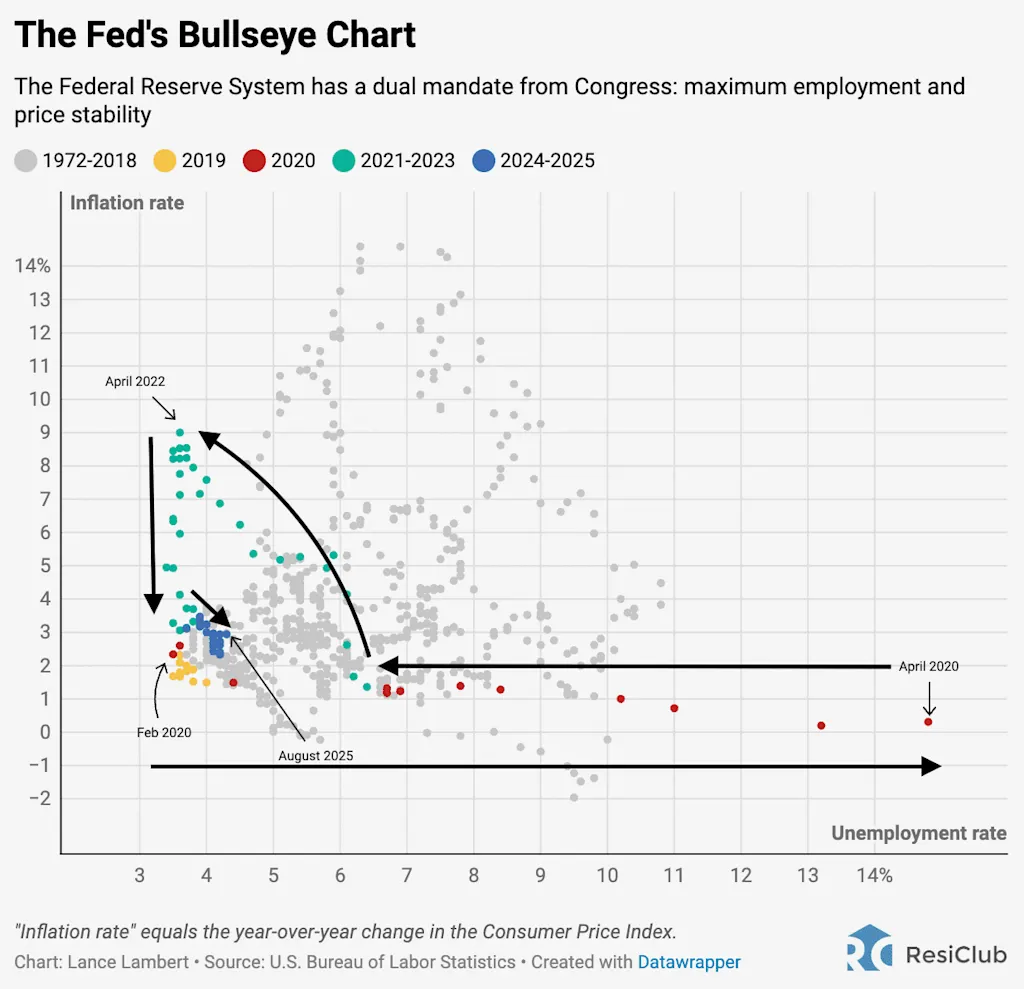
Big picture: IF the average 30-year fixed mortgage rate falls to 5.0% anytime soon, Bank of America believes it would likely be because the economy has taken a negative turn—or perhaps because the central bank adopted a new policy approach—and resumed buying mortgage-backed securities.
