

Decades Later, the Truth Behind a Grisly Mass Murder in El Salvador
Gettinger told Smith that the tape’s technical deficiencies, the lack of corroborating evidence, and the lingering questions about the police “combine to limit its usefulness.” Besides, why struggle to decipher the inaudible passages since the evidence wouldn’t be admissible anyway?
Nevertheless, he asked Killer to take one more crack at it. He found him in an ugly mood, and after polishing off the better part of a bottle of whiskey, the lieutenant refused to go on, just as they reached the critical passage about what happened at the airport.
Embassy officials did their best to find out more, fretting that if the tape ever came to light without a satisfactory explanation to Congress of “the police angle” or the “lateral involvement” of a second security force, they wouldn’t “have a leg to stand on.”
Smith pressed the issue with the attorney general, the prosecutor, and the embassy’s legal adviser. “Méndez [the legal adviser] had been a boxer, and he was a tough character,” he recalled. “But the AG didn’t want to do anything. We met him late at night, and the man was terrified.” There was “absolutely no interest” in opening a can of worms about the police.
The only option that remained was to track down three material witnesses who might know more: two guardsmen who had been on duty in the airport parking lot and might have communicated with the police, and the corporal left in charge of the guard post when Colindres Alemán set off that night. Alas, the national guard reported, all three witnesses were dead: one in combat, one MIA, and one in a car crash. “Such things happened often in sensitive cases,” said Terry Karl, the Stanford expert on the Salvadoran military, “especially as they learned to make their cover-ups more sophisticated.”
Finally, Convictions
The FBI’s hands were largely tied, Smith said, “because until 1986 there was no federal statute making it a crime to murder an American citizen outside the U.S.” The bureau had collected fingerprints, run polygraphs, analyzed ballistics, but none of this was admissible in court. Its role was restricted to assisting the national police, which meant deferring to Márquez—now promoted to lieutenant colonel—who controlled the criminal investigation.
In late June, an FBI special agent arrived in San Salvador for a two-week visit. With the high command on notice that U.S. military aid hung in the balance, it was finally time to throw the five guardsmen to the wolves, and Márquez could not have been more cordial. The American and the Salvadorans peered through high-powered microscopes, test-fired bullets into an Olympic-size swimming pool, and in the end produced evidence that would stand up in court. The trip ended with a convivial social evening.
As for the CIA, with the death squads resurgent, Director Casey flew down to San Salvador to tell Col. Carranza to rein them in. Such distasteful tactics might have been effective in 1980, but they were now counterproductive.
The FBI’s intelligence division asked Casey to share with Judge Tyler all CIA documents relevant to the case, pointedly reminding him that Secretary Shultz expected full cooperation. The agency offered up 10 documents. Most were boilerplate, but four lengthy cables were almost entirely redacted, citing “the extreme sensitivity of the sources and methods by which the information was obtained.” Even the fragments that escaped the black Sharpie were classified secret, and the CIA insisted on prior review of Tyler’s report before it went to Congress. His associate, former Secretary of the Army Togo West, sent the packet straight back, with a frosty note saying it was useless.
Jeff Smith had no recollection of seeing any of this correspondence. “We told Congress and the families in good faith that we didn’t know who was ultimately responsible for the murders,” he said. “But if there was such knowledge at the time, and we were not told, I would be very angry. I can think of no legitimate reason why we should not have been given that information.”
“Presumably you had top-secret security clearance?” I asked.
“Oh, my clearance went much higher,” he replied, “what’s known as SCI, Special Compartmented Information, which gives you access to projects that are specially protected by codewords.”
Under the Freedom of Information Act, I requested expedited processing of the release of the most heavily redacted CIA documents, but my request was denied. Yet the documents volunteered by Casey weren’t the only issue, because I’d found many more secret CIA cables that were germane to the churchwomen’s case, all dated before the FBI’s request. The most significant of these was written in March 1983. It was a detailed analysis of the history, structure, leadership, and membership of the death squad that was run out of national police intelligence, dating back to 1979 and the assassination of Archbishop Romero. Márquez was its commander. Inspector Salazar, who had led the initial investigation into the women’s disappearance, ran day-to-day operations. Capt. Rafael López Dávila, Márquez’s deputy, oversaw a secret torture and execution center, a guarded compound near the airport, on the road from Zacatecoluca to La Libertad. René Emilio Ponce provided false documents and license plates for vehicles used by the death squad. Roberto D’Aubuisson sometimes selected the targets for assassination.
In December, Vice President George H.W. Bush traveled to El Salvador to read the riot act. Stringham had given him a list of eight military death squad leaders, which Bush handed to Vides, demanding their removal from their posts. The two most senior were Márquez and Denis Morán, head of national guard intelligence, who was now operating a new death squad in Zacatecoluca, where the trial of the churchwomen’s killers would be held.
El Salvador’s top commanders duly signed a pledge to eradicate the death squads, and Vides appointed a commission to investigate human rights abuses by the military. It was headed by a national guard intelligence officer, Capt. Ricardo Arango Macay—a veteran, along with D’Aubuisson, Staben, and Morán, of the White Warriors Union, a death squad that specialized in killing priests.
And CIA support for national police intelligence continued. In March 1984, López Dávila gave a young freelance reporter a tour of the revamped police files on suspected “subversives.” The intelligence came from the CIA, he explained. “[The Americans] receive information from everywhere in the world,” added Carranza. “It’s very helpful.”
And so, the churchwomen’s case limped its way to the finish line, and on May 24, 1984, Colindres Alemán and four others were convicted of aggravated homicide and sentenced to 30 years’ imprisonment. The military had made an unavoidable but ultimately small sacrifice, and the firewall around senior officers and the police had held.
With the convictions secured, Congress immediately approved $62 million in emergency aid. That same day, a new set of military transfer orders went through. Carranza and Márquez were quietly sent abroad as military attachés, and Morán headed for Washington for further training at the Inter-American Defense College. There are times when coincidences of timing stretch credulity.
Remains of the victims of the 1981 El Mozote massacre; a photograph showing the walls of a burned house and charred remains under the fallen ceramic roof tiles. The two-story cement house in the background was the only structure that revealed the location of that home in 2001.
SUSAN MEISELAS/MAGNUM PHOTOS (X2)
The Secrets of the Tape
Judge Tyler’s belief that Colindres Alemán acted without higher orders rested on the national guard-national police investigation and what Gettinger had gleaned from Killer’s secret tape.
Tyler had trusted in Maj. Medrano’s professionalism, and no doubt that was how he presented himself. Not all officers conformed to Gettinger’s stereotype of “uniformed thugs with blood dripping from their mouths.” But in fact, Medrano, trained in urban counterinsurgency at the School of the Americas, went on to become head of national guard intelligence. In 1986, he was identified by Salvadoran and U.S. intelligence officials as having himself been active in death squad operations.
But there were too many unexplained gaps in the recording, too many discrepancies in the evidence, too many dead witnesses. Only the tape could provide clearer answers, but it had never been declassified and had long since vanished. Last year, as I was working on this story, officials at the State Department and National Archives agreed to search for it, but they came up empty, and I assumed we’d reached a dead end.
Then, out of the blue, many months later, one of the officials called to say he’d found it. It had been reviewed, digitized, and approved for declassification.
With the help of state-of-the-art audio software, I spent five hours poring over the 19-minute recording, with three Salvadoran interpreters conferring until they agreed on every word, penetrating the local slang and the welter of obscenities, watching fascinated as multicolored bands of sound danced across the screen, filtering out background noise and unwanted frequencies, until it was possible to piece together the missing parts of the puzzle.
Perhaps the darkest irony of the tape was why Colindres Alemán trusted Killer enough to confide in him. They’d met in the fall of 1980 at the School of the Americas, attending a short-lived course—canceled by the Reagan administration—on human rights. I tracked down the class roster. Other than Killer, only a handful of officers had participated, but among them were López Dávila of police intelligence, and Chávez Cáceres of the police academy, who had commanded the stakeout of the airport.
The tape confirmed that Colindres Alemán had gone out to the parking lot to meet with the national police at the airport, who told him that the women were “subversives.” According to the confidential internal report of the U.N. Truth Commission, the national guard sergeant had driven to the nearby treasury police post at about the same time to alert them that an operation was imminent, possibly involving gunfire. So all three security forces under Carranza were now woven into the web of complicity.
After the Maryknoll sisters’ plane arrived from Managua, Colindres Alemán told Killer, he had met with an unnamed lieutenant stationed at a computer, part of the newly upgraded communications and intelligence facilities at the airport. The officer told Colindres Alemán that they were on their way to the funeral of the murdered FDR leaders and showed him correspondence they’d been carrying, destined for una mera—“a top woman,” in Salvadoran slang—in La Libertad. They were suspected, Colindres Alemán said, of “transporting weapons and I don’t know what else to a cantón over by Zaragoza,” where the Cleveland diocese had just opened its shelter for orphans fleeing the violence in Chalatenango.
Colindres Alemán said he would take care of the problem. Later, when he searched the women’s minivan, he told Killer, he found un vergón—a shitload—of what he called “propaganda.”
“And that’s how the job was done,” he went on. “We smoked them over by Santiago Nonualco.”
The naked brutality of Colindres Alemán’s language was enough to persuade Gettinger that the sergeant had acted alone.
Accusations by more senior military leaders that the churchwomen had been “subversives” bothered the embassy’s Marine attaché so much that he raised the issue in a confidential October 1983 cable to the Joint Chiefs of Staff, describing a conversation with a military source about the murders. The contents of the cable and its sloppy redactions point strongly to Roberto Staben, who had been in charge of intelligence and operations in La Libertad and Zaragoza. Now, newly promoted to command an elite battalion, he was about to embark on joint combat operations with Domingo Monterrosa’s Third Brigade.
The women had been “terrorists,” the officer said; it had just been a “simple wartime execution.” But what on earth justified that preposterous charge, the attaché asked. What were they supposed to have been taking to the guerrillas? “Messages, medicines, shoes, clothes, and that sort of thing,” the officer replied. The sort of things a humanitarian aid worker might be expected to take to a shelter for refugee orphans. These comments, the Marine concluded, “reveal again that a different mentality and a different logic exist in El Salvador which does indeed make effective communications between respective societies sometimes extremely difficult.” But it was a logic to which the United States, whatever its moral qualms, found itself wedded by the bottom-line goal of winning the war.
Judge Tyler’s version of what happened on the night of December 2, 1980, suggesting that Colindres Alemán had acted on his own initiative, has been passed down unchallenged in 40 years’ worth of books, articles, documentary films, and human rights reports. But that story falls apart once the secrets of Gettinger’s tape have yielded to today’s technologies. If the women were detained and searched at the airport, it corroborates an entirely different version of events, one that Paul Schindler had recounted to Tyler, who rejected it as a “red herring” simply because it conflicted with the story crafted by Maj. Medrano and the national police.
Schindler repeated it to me over our lunch at the parish house in La Libertad. He always took it for granted that the military had murdered the women, but after taking the bodies of Donovan and Kazel back to Cleveland for burial, his only concern was to be there for his parishioners, at a time when other priests were fleeing the terror. Some of those who flocked to his church to offer condolences worked at the airport. When the plane from Managua landed, the terminal was about to close for the night, and given the dangers of being out after dark, workers on the evening shift often slept over. “They saw all the passengers leave,” Schindler said, “apart from Dorothy and Jean, who were still waiting, until finally a couple of guys in uniform took them off to an inner room where Ita and Maura were already being held. That’s where they were detained. The rest is all nonsense.”
“No lowly sergeant in the national guard would have had the authority to interrogate suspects like the American nuns,” said Argentine lawyer and military expert Alfredo Forti, an investigator for the Truth Commission. “Only an intelligence officer could have done that, and it could only have been done following superior orders and in a secure location.”
That pointed clearly to a military training base called the Cuartel de Miraflores, which covered hundreds of acres of desolate scrubland and forest just a 10-minute drive from the airport and exactly matched the location of the guarded compound where, according to the CIA, Capt. López Dávila had run the national police’s secret torture and execution center. “Taking the women there was indeed the most logical scenario to reduce the risks in such a sensitive operation,” Forti said.
“Oh yes,” Paul Schindler said, as if it was obvious. “The Cuartel de Miraflores was the base for the death squads in that whole area.”
The Persistence of Memory
During that time of madness in El Salvador, we often heard talk of the “fog of war”—how hard it was to understand the military’s eccentric command structure. But the extremists were always a coherent clique, and once Gettinger’s tape and Schindler’s story were added to the mosaic of evidence, you could see clearly the roles that many of its leading members, colonels and majors, had played in the churchwomen’s case: Carranza, responsible for joint security force operations; Monterrosa, for the surveillance of the airport; Casanova Véjar, for all forces in the department of La Paz; Staben, for intelligence on the women’s work in Zaragoza; Márquez, for the criminal investigation. Over and above their brutality, all these officers had one thing in common—their close ties to U.S. intelligence.
What the leaders of the Salvadoran death squads and others of their kind invariably underestimate is the power and persistence of memory. Each year on December 2, religious communities around the world still gather to honor the four churchwomen on the anniversary of their deaths. Human rights experts like Terry Karl doggedly pursue war criminals in foreign courts.
For Jeff Smith, the top State Department lawyer on the case, what remains at stake four decades later is the integrity of U.S. foreign policy. “Beyond pressing for justice in El Salvador,” he said, “this was about fostering the broader principle of the rule of law.” Smith went on to serve as general counsel of the CIA during the Clinton administration, and the agency’s role in the affair touches a raw nerve. “This was such a significant case that it’s important to know what was redacted from those cables,” he said, “and whether everything the CIA knew was shared with Judge Tyler and other senior officials. So it would be appropriate for one or both of the intelligence oversight committees in Congress to request full access to those cables and any other documents relevant to the agency’s relationship with Salvadoran security forces.”
By the time the war ended in 1992, 75,000 Salvadorans were dead. Domingo Monterrosa’s Atlacatl Battalion left a trail of tears wherever it went. It was Atlacatl commandos who murdered the Jesuit priests in 1989, on orders from a cabal of colonels headed by René Emilio Ponce, leader of the tandona and an alumnus of the national police death squad. Roberto Staben’s name was often associated with El Playón, a volcanic lava field that was the most infamous of the death squads’ body dumps. He and José Alfredo Jiménez Moreno, Monterrosa’s old sidekick from the police academy and the Atlacatl, went on to operate a kidnapping ring that netted millions from rich businessmen.
Many are dead now. Monterrosa himself was assassinated in 1984 by a bomb placed in his helicopter. His subordinate, Lt. Chávez Cáceres, perished in a car crash in 1991—ironically, on the airport highway. Roberto D’Aubuisson died of cancer the following year, and Ponce of natural causes in 2011. Nicolás Carranza passed away peacefully in Memphis, Tennessee, in 2017, a naturalized U.S. citizen, a pillar of his local church. He said his only regret was having worked for the CIA. Arístides Márquez died in 2019, Vides in December 2023, and Casanova Véjar, his cousin, last July.
Others live out their golden years quietly in El Salvador, keeping in touch with old tanda-mates on Facebook, grumbling at efforts to reopen old cases like the massacre at El Mozote. As for Carl Gettinger’s informant, Lt. Merino, he was reportedly murdered by unknown assailants sometime in the 1990s. Common crime? A personal vendetta? Long-delayed retribution for his betrayal of the national guard? “All I know,” Gettinger said, “is that he would have gone out with guns blazing.”
Epilogue: The Long Tail of War
Paul Schindler, now 84, intends to spend the rest of his days in La Libertad; he’s already chosen his burial place. He took me to see the spartan upstairs room where Jean Donovan had slept, occupied now by a housekeeper. On a street behind the church, there is a colorful mural with portraits of the four women and Archbishop Romero. When a new mayor was elected a few years ago, a member of D’Aubuisson’s old ARENA party, he’d ordered it painted over. Schindler had it painted back again.
The coastal strip around the port, with its miles of golden beaches and booming breakers, is a tourist mecca these days. A new four-lane bypass leads to Surf City, site of the 2023 World Surfing Games. Beyond that is a place called El Mirador, where Schindler once found the decomposing remains of five death squad victims dumped at the foot of the cliffs. Today it’s just an idyllic, palm-fringed crescent of sand, encircled by resorts and Airbnb rentals.
In Santiago Nonualco, next to the chapel that was built where the women’s mangled bodies were found, villagers recently added a small white monument, decorated with sculpted angels, photographs of Ford, Clarke, Kazel, and Donovan, and the text of the Beatitudes in the Gospel of Matthew: “Blessed are the meek, for they shall inherit the earth…. Blessed are the peacemakers, for they shall be called children of God.”
The Cuartel de Miraflores remains in occasional use today as an army training base. It still has a forbidding air, with a crude metal gate behind which a dirt track disappears into the dark subtropical forest. The road from there to Zacatecoluca is dotted with evangelical churches, simple one-room structures with a few cheap plastic chairs. One consequence of the war, said the bishop of Zacatecoluca, Elías Samuel Bolaños, is that much of his congregation has been lost to the Pentecostals, who offered a simple path to salvation and “attacked the church for its social engagement, its work with the poor.”
In 1980, there were 95,000 Salvadorans in the United States; when the war ended, there were over a million. Their exile communities nurtured vicious criminal gangs like Mara Salvatrucha, MS-13. Deported en masse in the 1990s and 2000s, these engulfed El Salvador in a new reign of terror. By 2015, the nation had the highest homicide rate in the world, generating a new exodus, stoking the nativist rhetoric of Donald Trump’s first election campaign.
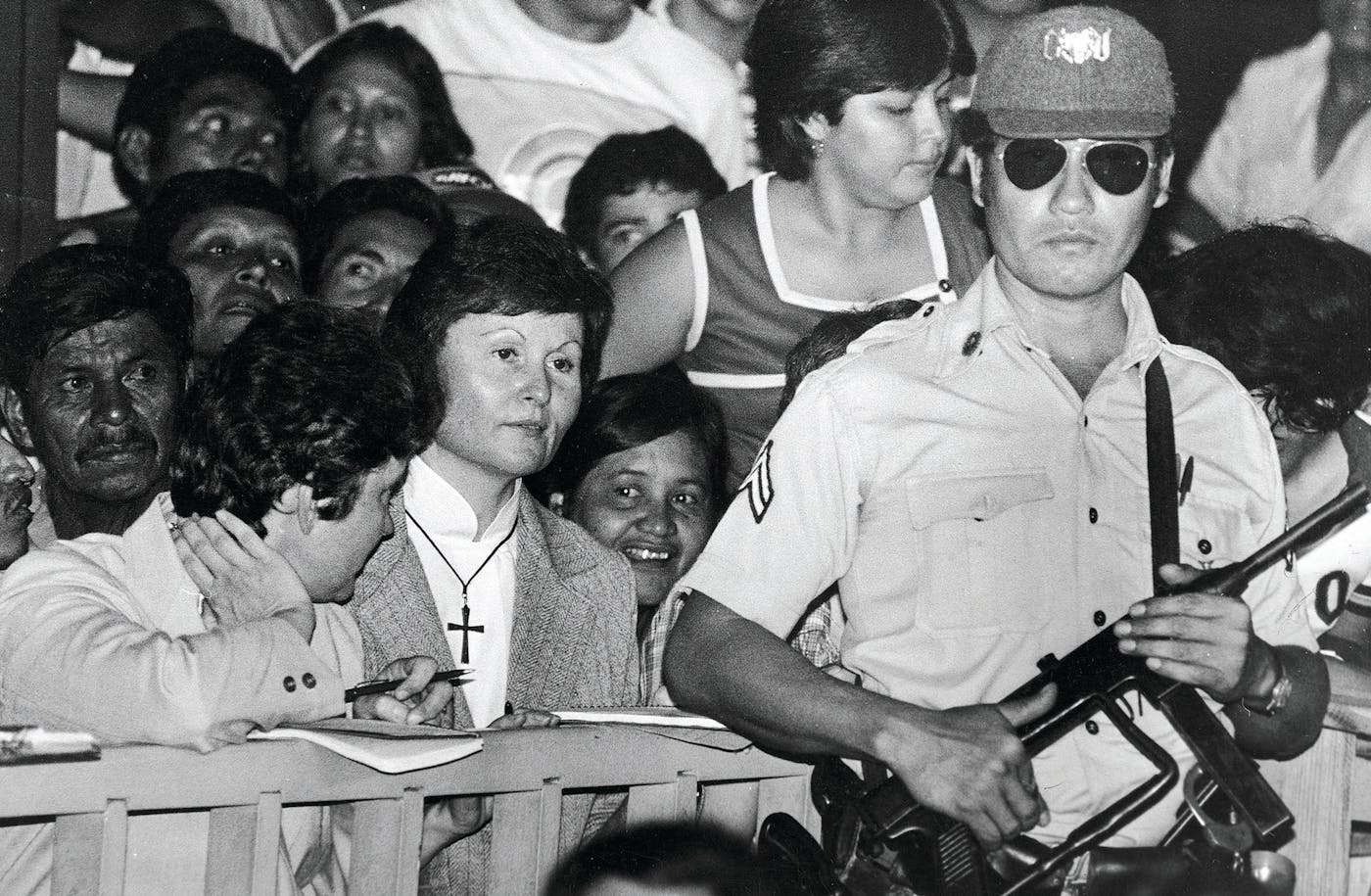
Maryknoll nuns Bernice Kita (left) and Helene O’Sullivan attended the 1984 trial of five former national guardsmen later convicted of aggravated homicide in the deaths of the four women.
LUIS ROMERO/AP
The worst of the gang leaders were jammed into a maximum-security jail in Zacatecoluca, familiarly known as Zacatraz. Since then, the populist president, Nayib Bukele, has suspended many civil liberties, firing judges and opening the world’s largest prison, five miles from Zacatraz, with a capacity for 40,000 inmates, now including the alleged Venezuelan gang members sent there by the Trump administration. In a traumatized society, these draconian measures are wildly popular, and Bukele has become a star of the Trumpworld firmament, his inauguration for a second term last June attended by a group of MAGA luminaries that included Donald Trump Jr., Tucker Carlson, and Matt Gaetz. In February, in a post on X, Elon Musk applauded Bukele’s purge of the judiciary: “That is what it took to fix El Salvador. Same applies to America.”
“In a country where judges and lawyers were threatened and assassinated, we fought to bring to justice those who raped and murdered four courageous churchwomen,” said Jeff Smith. “And now Musk is praising Bukele’s attacks on the justice system. What are those women telling us from the shadows that we should do in our country today?”
Both the gangs and the Pentecostals had put down deep roots in places like Apopa, a downtrodden city on the road to Chalatenango. It was in Apopa that I found Sgt. Luis Antonio Colindres Alemán. He was granted early release in 1998, part of a program to relieve prison overcrowding. He’d been a model inmate, the warden said, keeping to himself, making furniture to earn a little money. Freed from jail, he made no secret of his bitterness at being scapegoated. “Why were we singled out?” he asked local reporters. “Why us? What was the purpose behind this?”
Today he is the pastor of a small Pentecostal church in Apopa, an affiliate of the Assemblies of God.
“It’s true that I experienced situations of extreme violence,” he said when I asked him about the war. “The international situation in those days was very complicated.” When I mentioned his service in the national guard, he hesitated. “Call me later and we can talk more,” he said at last. I sent him several follow-up messages, but he never responded, and in truth, I hadn’t expected him to.
El Salvador had never made peace with its past. But could an individual like Colindres Alemán, capable of such barbarity, find personal redemption? Maryknoll Sister Helene O’Sullivan, who had attended the trial of the guardsmen with Carl Gettinger, didn’t find this a useful question. “Instead of looking at him, we Americans need to look at ourselves,” she said. “The violence, the refugees, the deportations, the gangs, the evangelicals—the United States government created all this and left Salvadorans with a twisted society. If we question our own actions, perhaps we can make a difference. As for Colindres Alemán, that’s between him and his God.”