
Ear Seeding Offers *Real* Benefits—Here's Proof
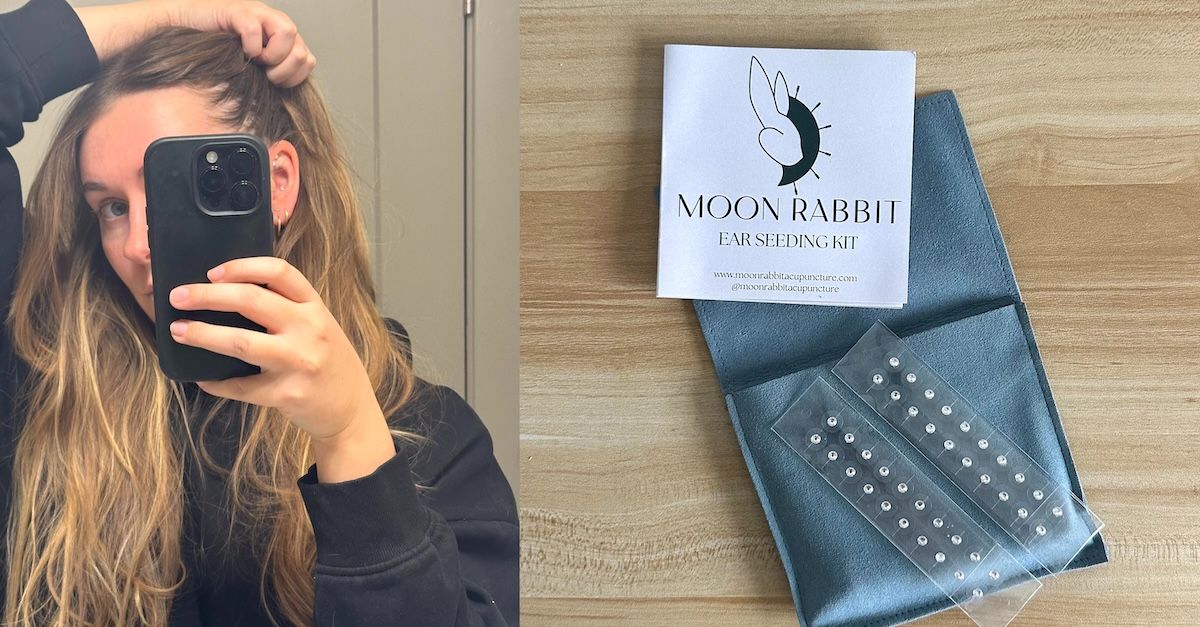
Lately, I’ve been seeing ear seeding content flood my FYP on Instagram and TikTok. (You know how the algorithm works—you engage with one video and you’re suddenly served 100.) If you’re like me, this isn’t a term or a topic you’re familiar with. So if you’re asking me what on earth ear seeding is, I get it. Allow me to explain. Ear seeds are tiny magnets, dots, or balls that are applied to the outer ear and secured with adhesive. The idea is to place them on specific pressure points, which can provide certain skincare and wellness benefits. Proponents of the practice say it can do everything from facilitate lymphatic drainage to sculpt the appearance of the skin and even reduce anxiety and alleviate insomnia.
Ear seeding is taken from traditional Chinese medicine (TCM), so while it’s not new, it seems to be trending nonetheless. In one video, a content creator applies ear seeds ahead of a long-haul flight, stating that she won’t fly without them, because they ease her anxiety. In another, a content creator places ear seeds on one ear but not the other. After a few hours, the ear-seed side of her face looked like it had been treated to a luxury facial; it was more lifted, sculpted, and defined than the other side. Intriguing? Yes, but I wasn’t sold just yet. I’ve been a beauty editor long enough to know research is required before jumping into anything, internet-viral or not. And, often, TikTok and Instagram don’t communicate the history and context behind any given product or practice. So I did what any good beauty editor would do, and I reached out to the experts. Ahead, read what dermatologists and TCM doctors have to say about ear seeding.
The History of Ear Seeding
Gudrun Snyder is the founder and CEO of Moon Rabbit. She’s also a doctor of acupuncture and Chinese medicine. “Ear seeding is ancient—its roots go back thousands of years in traditional Chinese medicine,” she says. “The idea is that the ear is a microsystem of the body, with different points corresponding to organs, emotions, and systems. In the 1950s, a French neurologist mapped the ear in the shape of an inverted fetus and helped formalize what’s now called auriculotherapy, but the foundation was already deeply established in TCM.”
You may like
Haley Parker is a board-licensed acupuncturist and herbalist as well as a professor and director of clinical operations at Virginia University of Integrative Medicine. She seconds this, saying the concept comes from TCM, and it’s based on the idea that the ear is a “microcosm: a small reflector of the entire body and nervous system.” However, systemic auriculotherapy maps (like the ones found in modern acupuncture clinics) were formalized by French physician Paul Nogier in the 20th century. “Ear seeds specifically are a noninvasive extension of this tradition, providing acupressure rather than needle puncture,” she says. “Ear seeds became popular as a gentle, accessible option for people who want acupressure without needles.”
Interestingly enough, Snyder says it’s called “ear seeding” because practitioners would traditionally use the seeds of the Vaccaria plant, which are small, round, and “perfect for applying pressure” as in acupuncture, but without the needles. “These days, we’ve zhuzhed things up with gold, stainless steel, and even Swarovski crystals. So they’re not just functional—they’re also kind of fabulous. Healing, but make it chic.”
Wellness Benefits
This is the burning question, and it seems the answer is yes—mostly. Let’s talk about ear seeding regarding wellness benefits first (namely, stress, anxiety, sleep, and pain). Snyder says ear seeding can legitimately improve all of the above. “When done correctly, ear seeds are incredibly effective. They’re based on auriculotherapy, a traditional Chinese medicine technique that treats the ear as a map of the entire body. Specific points on the ear connect to different organs, systems, and emotional states. When you apply light pressure to those points with a seed, you're essentially sending a message to your body to reset, regulate, or rebalance. We use ear seeds in the clinic all the time to help with stress, sleep, pain, and anxiety. It’s like acupuncture you can take home with you.”
Parker agrees, saying there’s truth to the claims, albeit with important clarifications. “The outer ear is highly innervated and reflects the nervous system. For years, clinicians have used points on the ear to influence stress response, sleep regulation, and pain modulation. Ear seeding provides constant acupressure stimulation throughout the day, which can support many things like pain and ‘fight or flight’ stress.” Parker says ear seeding is so impactful that some of her patients notice the moment the ear seeds fall out.